

Ahead of the Intermodal Association of North America's IANA EXPO 2026 we decided to ask ChatGPT, Gemini, and Perplexity a question: "What intermodal company has the best marketing?"
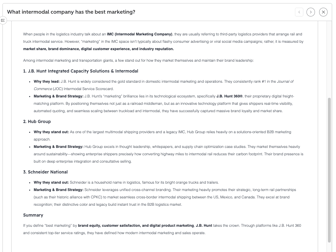
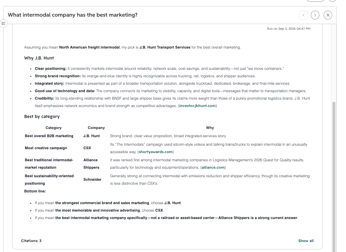
Every single answer pulled from the same short list: J.B. Hunt, CSX, Schneider National, Matson Logistics, Alliance Shippers. Big, established, asset-based carriers, all of them already household names in the industry. Three different AI tools, zero surprises.
That's not really a story about marketing. It's a story about how AI search works, and it says a lot about what's coming for every company in this industry that isn't already a household name.
Here's the part most people outside the industry don't know, and it makes the question funnier the more you think about it. Intermodal has an entire company category built around outsourced marketing. When the Staggers Rail Act of 1980 deregulated freight rail, the ICC freed intermodal from its old rate restrictions the following year, and volume took off. "Deregulation was very important for both the intermodal and railroad industry, as it allowed them to price to the market and offer the service customers were looking for," Phillip Yeager, founder and chairman of Hub Group and one of the industry's recognized founding fathers, told Progressive Railroading.
Railroads had already made a deliberate choice not to sell directly to individual shippers, also known as beneficial cargo owners, or manage the sales and customer service that comes with it. Instead they sold wholesale to a new category of business built to do exactly that, a company whose entire job, literally in the name, was sales and marketing on the railroads' behalf: the Intermodal Marketing Company, or IMC. Ask an AI tool who has the best marketing in intermodal today, and it's still, in a roundabout way, answering a question this industry built into its own org chart more than forty years ago.
The name has actually become its own point of confusion as IMCs today spend far more time on logistics execution, securing equipment, managing dray capacity, tracking shipments, than on anything resembling marketing in the modern sense, and there's a real conversation happening in the industry right now about rebranding the category as "Intermodal Logistics Companies" instead. If an entire industry can't settle on its own name after forty years, it's not exactly surprising that AI tools default to guessing at the biggest brand instead of parsing the nuance. A savvy shipper however? Well that’s a different story.
The No-Click Reality
Cold calling has lost its edge. The market is flooded with generic content and every inbox is full. Meanwhile, the era of "no click" AI search is quietly reshaping how prospects find anyone at all when they proactively research a solution.
Here's what that looks like in practice: a shipper types a question into ChatGPT, Perplexity, or Google's AI Overview instead of scrolling through search results. The tool gives them an answer, often with a short list of companies attached, and the shipper never visits a website at all. If your company isn't in that list, you didn't lose the click. You never had the chance to make one.
The tactics that built pipelines five years ago are doing less work every quarter. But the tactics that replace them aren't complicated, and they're not equally available to everyone. Here’s the good news: the companies that win in this environment aren't always the biggest, they’re often simply the most specific.
Why Niche Beats Broad in AI Search
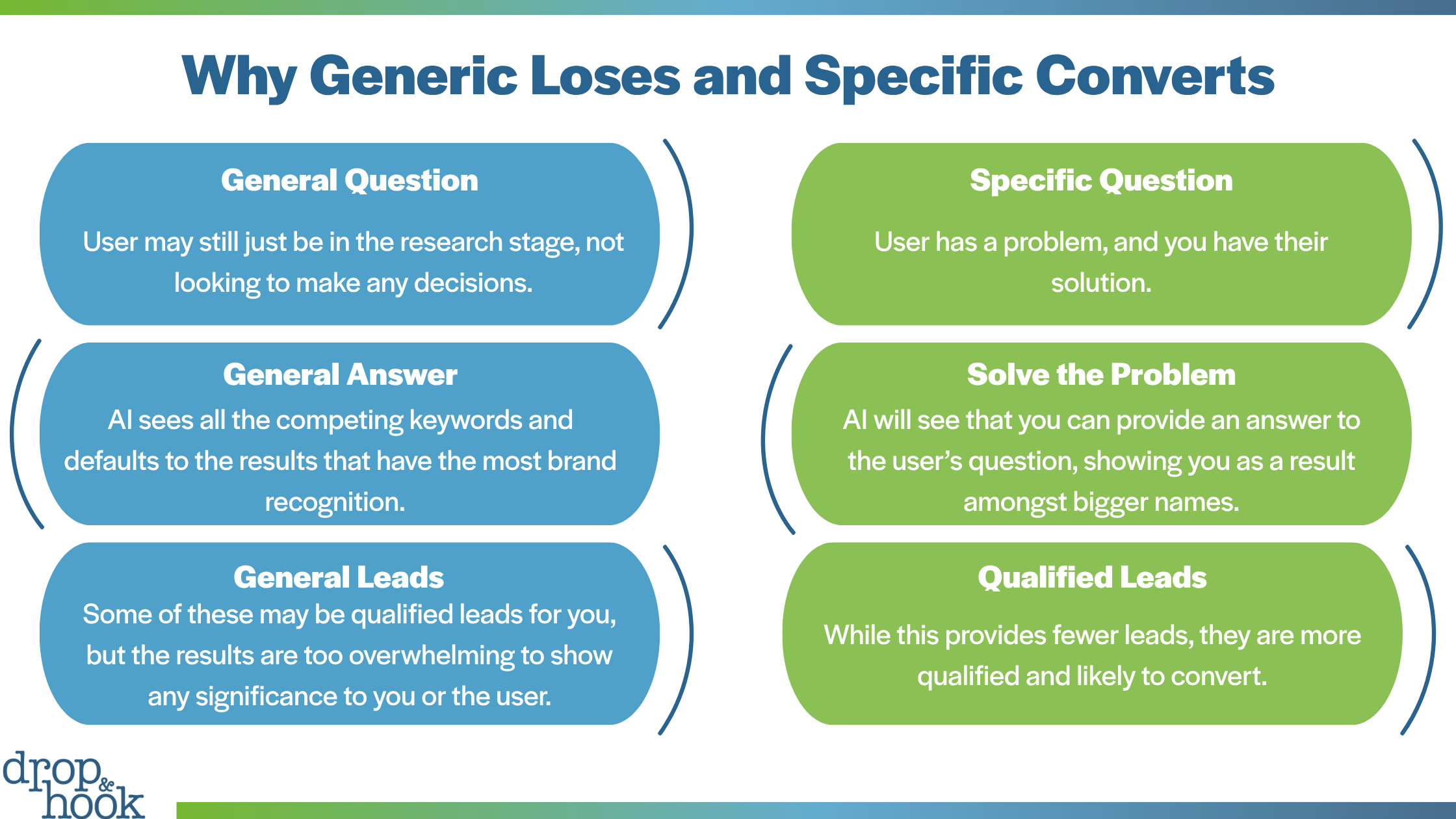
Broad content competes against everyone. A blog post about "logistics solutions" or "supply chain services" is fighting for attention against thousands of companies saying roughly the same thing in roughly the same words. AI tools have no reason to cite any one of them over another, so they usually default to whoever already has the most brand recognition, which is exactly what we saw with the "best marketing" question above.
Niche content doesn't have that problem. A specific answer to a specific question, drayage at a particular port, chassis pool management, dwell time reduction on a certain lane, has very little competition. Fewer companies have written about it clearly, so the ones that have are much easier for an AI tool to cite with confidence.
This is measurable, not just theoretical. LinkedIn is now the second most cited source across B2B categories in AI-generated answers, behind only YouTube, and ahead of G2, Capterra, Wikipedia, and Medium, according to a recent Meltwater and LinkedIn analysis of over 9 million AI citations. That share grew 26 percent in just the four weeks the study covered. The companies showing up in that data aren't necessarily the ones with the biggest ad budgets. They're the ones consistently publishing specific, credible content that answers real questions.
For a niche like intermodal, that's an opening most companies haven't claimed yet.
What Happens When the Question Gets Specific
The "best marketing" prompt was the fun one. So we tried asking a few questions an actual shipper researching partners might ask instead: "Can you recommend a reliable provider for intermodal transportation across the U.S.?" "What are the most cost-effective options for intermodal shipping services available?"
The answers widened out. J.B. Hunt and Hub Group still appeared, but so did IMC Logistics, ContainerPort Group, RoadOne Intermodal Logistics, and InTek Logistics, all specialists that never once showed up on the "best marketing" question. They earned their spot the moment the prompt got specific enough to match their expertise.
Here's the pattern across everything we pulled:
| Prompt | Who Got Cited |
| "Best marketing" (broad) | J.B. Hunt, CSX, Schneider National, Matson Logistics, Alliance Shippers |
| "Reliable, seamless transportation" | J.B. Hunt, Hub Group, IMC Logistics, InTek Logistics, C.H. Robinson |
| "Most cost-effective options" | J.B. Hunt, Hub Group, Schneider National, IMC Logistics, ContainerPort Group, RoadOne, C.H. Robinson |
| "Compare shipping rates" | Freightera, FreightFA, Freightquote, Loadsmart, Uber Freight (rate tools, not carriers) |
The broader the question, the more the answers concentrate around a handful of the biggest names. The more specific the question, the more room opens up for a company that actually specializes in that exact thing. Which would you rather reach: 1,000 generalist leads, or 10 truly qualified ones?
The Toolkit
Operating on a shoestring budget? Here’s more good news. None of this requires a big budget or a total rebuild of your marketing. It requires consistency and specificity, applied where it counts.
Audit your content for actual niche depth, not just volume.
Pull up your last 20 blog posts or LinkedIn updates. How many of them answer a question specific to your corner of intermodal, a particular lane, commodity, terminal, or service, versus how many are general industry commentary anyone could have written? If it's mostly the latter, you're competing in the crowded broad-question space where the biggest names already win by default.
Get your subject matter experts posting as themselves.
A dispatcher, ops lead, or account manager with real, specific intermodal knowledge could be a stronger citation source than a branded company page. Recent LinkedIn data backs this up directly: 75 percent of LinkedIn's AI citations come from individual member profiles, not company pages. If your experts aren't posting under their own names, you're leaving the most credible version of your content on the table.
Ask an AI tool about your specific niche, not just your company name.
Don't just search for your brand. Ask the kind of question your ideal customer would actually type, tied to your specialty, and see who gets cited instead of you. That gap is your content roadmap. Truly knowing your customer and their specific pain points is never a bad thing, but it comes in particularly handy here!
Where This Is Going
Intermodal is exactly the kind of space AI search should be citing niche experts on, and most companies in it haven't claimed that ground yet. The broad questions will keep going to the biggest names. The specific ones are still up for grabs.
We're digging into this in more depth, along with practical lead generation tactics for transportation and logistics companies, on Wednesday, September 16 at 2:00 p.m. Join Michelle LeBlanc of Drop & Hook and Annika Wood of the Transportation and Supply Chain Institute at the University of Denver for a session on using email, content, social, and AI to build authority and stay visible as traditional websites and SEO lose influence.
Register for the session here.