

What happens when users get their answers without ever clicking your website?
That’s not the future of search, it’s happening right now.
Search is changing fast. Instead of scrolling through links, users are getting instant answers from AI tools like ChatGPT and Google’s AI Overviews. And that means your content has to do more than rank, it has to be the source those answers come from.
SEO isn’t dead. It’s just evolving.
In this blog, we’ll break down SEO, AEO, and GEO and how to show up wherever your audience is searching.
SEO: The Foundation
SEO is still the backbone of search visibility. At its core, SEO helps search engines understand your content so they can deliver it to the right audience. And while ranking still matters, there has been a shift. SEO is no longer just about clicks. Instead, its focus is on building the authority that AI tools rely on when generating answers.
Fundamentally, there are a few things you can always count on web crawlers to favor on your site. For example:
Technical Performance
Your website must be accessible to everyone, everywhere to rank high. This includes users on mobile devices! Desktop formats give you more room to play with the structure of your site, but more than half of website traffic is from mobile devices. Websites have to not just be compatible with mobile devices, they cannot lose any functionality. Think about your own experience with websites. If you saw an engaging social post and clicked on the accompanying link just to find a gigantic hero image that takes several scrolls to get through with text squished into the right margin and a form with an obscured submit button, would you stay on the site? Probably not. The same thing could be said about speed. Your site has about two seconds to load before its ranking is affected. Furthermore, users aren’t going to engage with a “sketchy” site. This is why security impacts your SEO. A good first step is to ensure you have your (SSL) Certificate set up. Google has long considered HTTPS sites to be preferable to unsecured sites and sites without SSL will often display "Not Secure" warnings in the user’s browser leading to increased bounce rates. Even if you don’t collect information or hold transactions on your website, you will still want to take steps to protect users’ data and build credibility with web crawlers. In an era where freight fraud continues to make major mainstream headlines every element that establishes better brand trust helps!
Curated Content
Again, think about your experience with web browsing. If you’re scanning a web page for information that is casting a wide net with irrelevant keywords, you probably won’t want to continue sifting through the text to try and find your answer. The goal is to have your information reach the right audience, not to reach the largest number of people as possible. Jumbled paragraphs with arbitrary associations will result in more people clicking off of your site rather than absorbing your content. To reach the proper audience, use intentional keywords that match search intent. Be thoughtful with your copy so web crawlers can connect the dots and push your content to people who need it.
Not sure where to start? Think about your ideal customer profile. What questions will that individual most want answered? If you find that most inbound leads on your website aren’t actually qualified customers, you may be better served by narrowing your focus to reach a smaller number of more specific search terms. To play this out with a specific example, let’s look at the world of transportation management software. It may be tempting to target the broadest possible search terms in this space, but is an individual searching for that broad term the best possible customer for your company? An ideal customer for one company may not be for another!
Consider these three search terms a logistics technology company might be considering: "trucking software," "transportation management software," and "last mile software." Google Trends data over the past five years shows the first two terms generate consistent, measurable search interest while "last mile software" barely registers. That gap might make the niche term look like a dead end. But what if that’s the best description for the product?
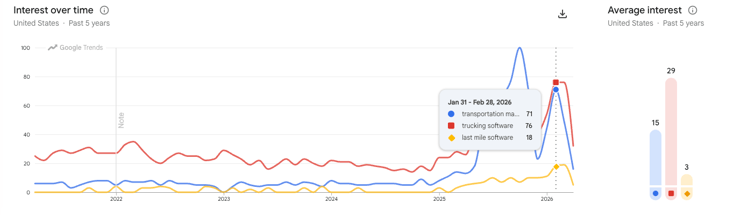
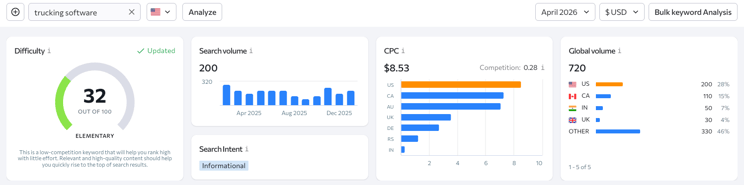
Looking at actual monthly search volume for our terms makes the picture much more interesting. From recent SERanking search data, "trucking software" and "transportation management software" pull 200 and 220 searches per month respectively, while "last mile software" comes in at 50. The numbers are closer than the Google Trends data implies, and more importantly, still not the whole story. It is worth noting that someone searching "trucking software" may not necessarily be a less qualified buyer, perhaps they’re a small business owner or an owner-operator, and they’re simply not someone who is likely to use more technical terminology in their research. For a TMS provider targeting small businesses, they each could be a relevant prospect, and importantly the “trucking software” option is a far less competitive keyword! To be successful we must know our target audience deeply and understand where we are speaking to them in their research process.
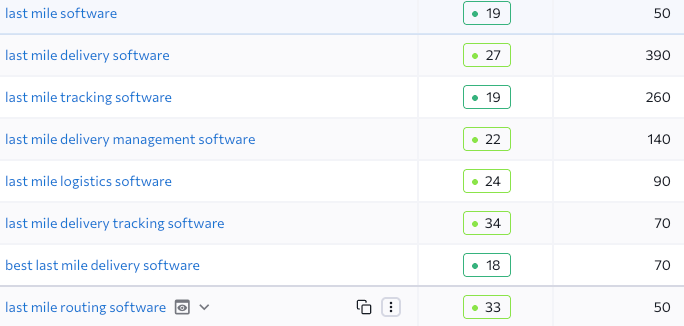
Now let’s take it one step further. When we dig into “last mile software” further we begin to see that there may be relevant related terms that have much higher volume, some of which may not be significantly more competitive to target. Others may only return small volumes, but for the right company, that volume may be extremely high value. For example, one niche term, "ecommerce last mile delivery software," sees only 10 searches on average per month. That number may sound discouraging, but consider this: someone typing that phrase has already self-identified their industry, their operational challenge, and their stage in the buying process, all in one query. For the right company, 10 searches from the right people will outperform 200 searches from the wrong ones every time!
 Domain Authority
Let’s be honest, anyone can build a website today. There are tools that can spin one up in minutes. So what actually makes your website stand out? That’s where domain authority comes in. Think of domain authority as your website’s credibility score in the eyes of search engines. It’s built over time based on the quality of your content, how your site is structured, and most importantly who is linking back to you.
When you consistently create helpful, well-optimized content, search engines start to see your site as a reliable source. But the real boost comes from backlinks. This happens when other reputable websites like industry publications, logistics or technology partners, or supply chain organizations link to your content. For example, if a well-known freight publication (like FreightWaves or TIA) references your blog on capacity trends or a partner links to your service page, that signals trust. It’s essentially a vote of confidence that says, “this site knows what it’s talking about.” Not all backlinks are created equal, though. A link from a trusted, authoritative site carries far more weight than one from a low-quality or irrelevant source.
Building domain authority isn’t a quick win. It takes time, consistency, and the right strategy. But as your authority grows, so does your ability to rank higher, attract the right audience, and become a trusted voice in your industry.
How Does AEO and GEO Factor Into This?
Having strong SEO will automatically make your site more appealing to Large Language Models (LLMs) like ChatGPT and Claude. However, that is not the only stipulation for being featured in generative AI. You have to strike the right balance between optimizing for search engines and LLMs. There are two main approaches to AI-friendly content: AEO and GEO.
AEO: Be the Answer
Answer Engine Optimization (AEO) is all about one thing: being the answer, not just another link. Search engines are prioritizing fast, direct responses. That’s what shows up in featured snippets, “People Also Ask,” and voice search results. AEO shifts the goal from getting clicks to providing the best answer. Even if users don’t click on your link, being featured in LLMs builds visibility, credibility, and trust.
To be seen by AEO, it’s important to focus on telling a story and putting meaning behind your content. Answer questions and provide valuable information that would make your content stand out. Avoid using generic terms or assuming your audience knows everything you know. Moreover, think about what questions people may actually ask as opposed to what you want them to ask. For example, a shipper isn’t typing in your company name, they’re asking things like, “How much does LTL shipping cost?” or “Who specializes in both FTL and LTL?” A driver might be searching “What trucking companies have the best benefits?” or “How to find a good carrier to work for.” If your content directly answers those questions, you have a much better chance of being featured. That’s where the shift happens. AEO isn’t about trying to get the click, it’s about earning the spot as the most helpful, trustworthy answer. And even if a user doesn’t click through, your brand is still front and center, building familiarity and credibility.
The bottom line: if your content is clear, relevant, and genuinely helpful, you’re not just competing for rankings, you’re positioning your brand as the answer.
GEO: Show Up in AI-Generated Answers
Let’s say you’re researching ways to prevent cargo theft. You might type into Google, “ways to combat cargo theft.” From there, you could click through multiple blogs and articles to piece together an answer, or you might just look at the AI Overview at the top of the page, which already summarizes key tips and best practices for you. Within that summary, you’ll often see links to the sources the AI pulled from. That’s where GEO comes in.
Generative Engine Optimization (GEO) takes things a step further than AEO. Instead of simply ranking content or pulling a single answer, AI tools gather information from multiple sources, interpret it, and generate a response in their own words. Your content isn’t just competing for visibility, it’s being analyzed, combined, and potentially used to shape the final answer.
And this shift is happening fast. Studies have shown that a growing percentage of searches now include AI-generated elements, and users are increasingly relying on those summaries instead of clicking through multiple links. In some cases, this has led to a rise in “zero-click” searches, where users get what they need without ever leaving the results page.
For logistics companies, this has real implications. If someone is researching topics like cargo theft prevention, freight costs, or last-mile delivery strategies, AI tools are pulling from the most clear, credible, and well-structured content available. If your content isn’t part of that pool, you’re missing the opportunity to influence the answer and the perception of your brand.
GEO applies across AI-driven platforms like Google AI Overviews, ChatGPT, Perplexity, and other conversational search tools. The goal isn’t just to rank. It's to create content that is clear, trustworthy, and structured in a way that AI can easily understand and use. Because in this new landscape, visibility doesn’t just come from being clicked, it comes from being referenced.
The Key Differences
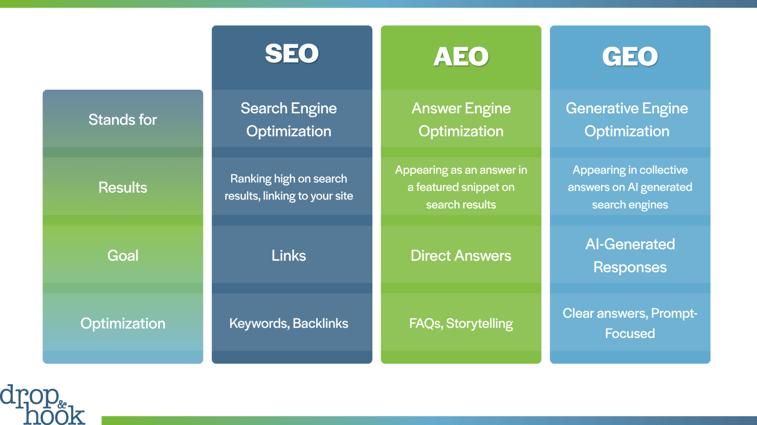
SEO, AEO, GEO, aren’t they all the same thing? The bad news is no, they aren’t the same thing and are all equally important in the quest for pushing your content. The good news is that you don’t have to choose just one method, and often the strategies overlap. Here’s a quick overview of the main differences between the three:
- SEO/Traditional search = links
- AEO = direct answers
- GEO = AI-generated responses built from multiple sources
If your content is used or cited, you can build brand authority, influence the answer, and reach users at an earlier point in their research. The shift is simple: It’s no longer just about ranking, it’s about being referenced.
Shifting Focus on SEO
You may be wondering if your SEO strategy is now obsolete. The short answer? Evolve, don’t replace. The previous approach to SEO was, “how do I rank #1?” The question now is, “how do I become the most trusted source?” The fundamentals of SEO still matter. But how you create and structure content needs to adapt. This can be done in a number of ways.
Answer Questions Early
The value of your page needs to be clear from the beginning. Start with the point, and then build it out as you go. While you may know that your topic is complex and nuanced, not all users have the time to become experts on the subject matter. That doesn’t mean your story or information are relics of the past. In fact, they’re just as important as ever for website crawlers and LLMs to get the full scope of your topic and contextualize it for their answers. On top of that, humans who are genuinely interested in what you have to say will keep reading if you are writing with them in mind.
Use Clarity and Scannability
Be honest. You haven’t read every sentence in this blog, have you? We get it, but that just proves the point that your content has to be scannable for human eyes as much as it is for bots. Structure your content in a way that is clear and comprehensible so it’s easier to find exactly what you’re looking for. Utilize headings and organize your content to flow through your points. Also, this isn’t the time to get creative with your narrative structure. You can save that for your screenplay. Just be simple and to the point.
Be Conversational
It’s definitely possible to be both direct and conversational in your writing. We’ve been pulling it off pretty well, haven’t we? Not only is it possible, it’s necessary for both SEO and AEO/GEO rankings. People tend to type out full sentences in their search queries whether or not they’re utilizing an LLM. Having a conversational tone makes it easier for the reader to understand, and it stands out to LLMs and web crawlers.
Optimizing Content for SEO, AEO, and GEO
Creating content that performs well today means thinking beyond traditional rankings. Your content needs to work for both search engines and AI-powered platforms.
Before writing for AI, write for humans. As mentioned previously, you want to focus on answering questions clearly and insightfully. Strong content still starts with quality, relevance, and trust. From there, you can structure your content for both AI and humans to understand by making it easy to scan and understand.
FAQ sections can also be especially effective. They help match common search queries, improve scannability, and increase your chances of appearing in featured snippets, AI answers, and “People Also Ask” results.
From a technical standpoint, structured data like schema markup can help search engines better understand your content and improve how it appears in search results.
Finally, authority matters. Citing credible sources, including expert insights, building internal links, and keeping your content updated all help strengthen trust with both traditional search engines and AI systems.
In short, content that wins across SEO, AEO, and GEO is clear, well-structured, trustworthy, and built to answer real user questions.
FAQs
We’re not going to miss out on optimizing this blog for search, so take a look at some frequently asked questions for SEO, AEO, and GEO!
Is SEO still important with AI search?
Yes, SEO is more important than ever. AI-powered search tools rely on high-quality, well-optimized content to generate answers. If your content isn’t strong from an SEO standpoint, it’s far less likely to be surfaced or cited in AI results. SEO is the foundation that AEO and GEO are built on.
How do I optimize for ChatGPT and Perplexity?
Focus on creating clear, well-structured, and authoritative content. Answer questions directly, use headings and bullet points for easy readability, and provide in-depth, accurate information. AI platforms prioritize content that is easy to understand, trustworthy, and comprehensive.
What is schema markup and do I need it?
Schema markup is structured data added to your website that helps search engines better understand your content. It can improve how your content appears in search results (like featured snippets or FAQs) and increases your chances of being used in AI-generated answers. While not required, it’s highly recommended.
How often should I perform an SEO audit?
At minimum, you should perform a full SEO audit 1–2 times per year. However, it’s best to monitor performance regularly and address issues as they arise. If your site is actively growing or undergoing changes, more frequent audits can help you stay ahead.
Can I rank in both traditional and AI search?
Yes, and you should aim to. With the right strategy, your content can rank in traditional search results while also being featured in AI-generated answers. The key is creating high-quality, well-structured content that answers real questions and demonstrates authority.
Where can I find qualified professionals to optimize my content for the future of search?
Your friends at drop & hook are ready to help you optimize your content in traditional search as well as in AI-generated answers! Whether you want to talk shop or partner with us to start your content optimization journey, contact us today!