

You don’t always need a massive budget to run paid ads that actually work. But you do need a strategy because in transportation and logistics, a small budget spent without direction disappears faster than a load posted on a hot lane!
This guide is for the transportation & logistics marketer who’s been told “we want to do paid ads” and handed something between a few hundred and a few thousand dollars a month. It’s for the solo marketing coordinator trying to figure out which platform makes sense. It’s for the freight broker who wants to generate B2B leads without the enterprise spend. And it’s for the carrier that keeps asking, “Are digital ads even worth it for driver recruiting?”
The short answer: yes, paid ads are worth it, even on a modest budget. But the reason most small-budget campaigns underperform isn’t the budget, it’s the absence of strategy before the spend. Let’s fix that together.
Marketing Budgets in Transportation & Logistics: Where Things Stand
According to the 2024 TMSA Marketing & Sales Metrics Study, over half of transportation and logistics respondents reported increasing their marketing budgets for the current fiscal year at the time. The share of marketers working with budgets of $1 million or more also grew, from 15% in 2022 to 19% in 2024.
That’s good news.
Here’s the reality check: the same study found that 51% of organizations have just one full-time employee managing multiple marketing functions, and 67% of all marketing activity is still handled primarily in-house. That means most transportation & logistics marketing teams are stretched thin, with limited resources and limited time to navigate an increasingly complex paid advertising landscape.
And when you factor in that organic social reach has declined steadily across every major platform over the past several years, the pressure to incorporate paid into the mix has never been higher.
The result? Plenty of marketers are dabbling in paid ads without a clear framework, burning small budgets on campaigns that don’t deliver, and walking away convinced that paid doesn’t work for their industry.
It does. It’s the strategy that’s missing.
Why Paid Ads Feel Scary (And Why That Fear Leads to Bad Decisions)
Paid advertising feels high-stakes when every dollar matters. And that fear produces predictable and predictably costly mistakes:
Mistake 1: Spending too much on creative, not enough on media. It’s tempting to invest heavily in polishing your ad before running it. But a beautifully produced video sitting in front of the wrong audience at too small a scale delivers nothing. Give your assets the spotlight they deserve by actually running them.
Mistake 2: Going too broad. Starting with a wide audience to “maximize reach” on a small budget is a fast way to generate impressions from people who will never become customers. Niche audiences convert. Start specific and build out from there.
Mistake 3: Running a single ad and calling it a test. Even strong creatives often need multiple touches before a cold prospect takes action. A single ad flight tells you almost nothing.
Mistake 4: Underallocating the budget overall. The most successful paid advertisers run a continuous mix of awareness and conversion-based campaigns. Many campaigns are meant to be ongoing, not one-time experiments. Spreading a tiny budget too thin across too many campaigns means none of them have enough fuel to generate meaningful data.
Mistake 5: Treating paid ads as a replacement for strategy. The platforms are just distribution channels. Before you spend anything, you need to know who you’re talking to, where they are in their decision journey, and what message will resonate with them at that moment.
A Brief Tour of Paid Ad Types for Transportation & Logistics Marketers
Paid advertising is not just one thing; it’s a collection of channels, each with different strengths, audience types, and minimum viable budgets. Here’s how the major platforms stack up for transportation and logistics marketers:
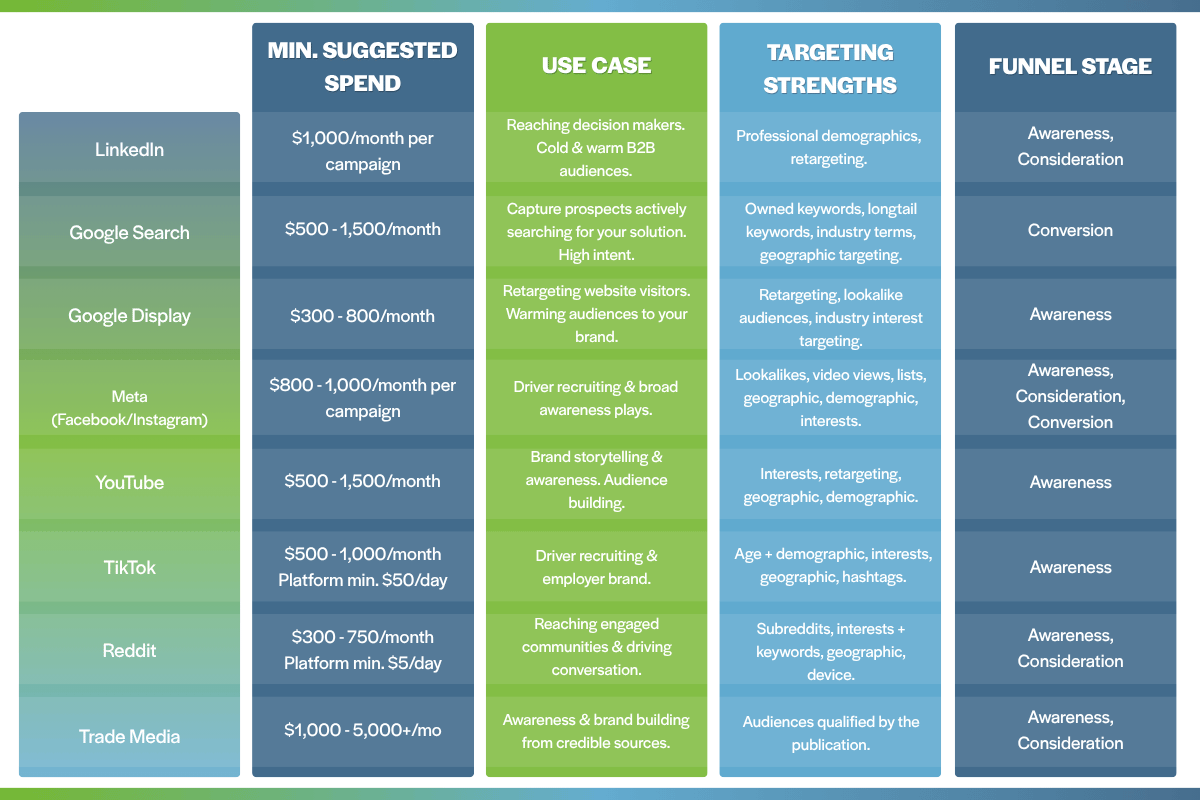
Budget ranges are estimates for small to medium business transportation & logistics marketers and will vary based on audience size, geography, and targeting competitiveness. For shoestring budgets, LinkedIn paired with Google Search is one proven starting combination for B2B transportation and logistics companies; Meta or TikTok are common entry points for driver recruiting. The right mix depends on your audience, goals, and where your brand already has traction.
Which Channels Actually Make Sense for Transportation & Logistics Marketers?
The right channel depends on who you're trying to reach, what you're asking them to do, and where they already spend time. That said, let’s look at a few common transportation and logistics use cases and what we’ve seen work running paid media & advertising campaigns for transportation clients across the industry.
If your goal is B2B lead generation (selling freight services, 3PL solutions, TMS software, etc.), LinkedIn ads for freight brokers and logistics companies remain the gold standard for reaching decision-makers by job title and company. It’s expensive relative to other platforms, but the targeting precision is unmatched. Pair it with Google Search to capture high-intent prospects who are actively looking for solutions.
If your goal is driver recruiting, the instinct is often to go where drivers are actively looking, such as sponsored listings on Indeed, for example. But active search isn’t what it used to be. Randall Reilly’s June 2026 30-Day Reset Report found that driver search interest hit its lowest point in 2026 and was down 21% year-over-year. Fewer drivers are actively searching, which means relying on job boards alone puts you in competition for a shrinking pool of candidates. That’s exactly where Meta (Facebook) earns its role as the workhorse channel for CDL recruiting. Rather than waiting for a driver to come to you, it lets you reach them where they already are, with targeting by geography, demographic, and interest, whether or not they’ve typed a single job search term. A smaller logistics company with a limited paid budget often gets more mileage from a well-targeted Meta campaign than from a sponsored listing competing against enterprise recruiters on a platform where driver intent is declining.
If you’re running brand awareness for a freight or logistics company on a limited budget, YouTube and Google Display offer cost-effective reach, especially when used as the entry point in a retargeting funnel (more on that below). Both platforms sell impressions at lower CPMs than social platforms, so you can build visibility for a smaller logistics brand without burning through budget and because anyone who watches your video or visits your site becomes a retargetable audience, that early awareness spend keeps paying off in cheaper conversions later in the funnel.
If you’re a tech company or SaaS provider serving the logistics and supply chain space, Reddit’s subreddit targeting (r/logistics, r/supply chain, r/truckers) can reach niche audiences of operations professionals at a surprisingly low cost. These communities skew toward people actively researching solutions rather than passively scrolling, so the audience arrives with built-in intent. LinkedIn is a strong fit for that same audience: its targeting by job title, function, and seniority level lets you put your message directly in front of supply chain directors, ops managers, or procurement leads by role, a level of precision no other platform matches.
If credibility and context matter most, trade media placements in publications like FreightWaves or Transport Topics put your brand in front of an already self-qualified transportation & logistics audience. Readers who subscribe to an industry publication are, by definition, already engaged with the space, which lends your message to a level of built-in trust that cold prospecting on social platforms can’t replicate.
Part Two: The Foundation You Must Build Before You Spend a Dollar
Most small-budget paid ad campaigns fail not because the budget was too small, but because the strategic layer was skipped entirely. Before you set up a single campaign, you need to get clear on three things: your audience, their lifecycle stage, and how those two factors map to the channels and content you’re going to use.
Step 1: Define Your Audience
Start by building out your ICP or target persona if you don’t already have one. This means getting specific about:
- Demographics: Industry, job title, company size, geographic location
- Psychographics: What problems keep them up at night? What do they care about? What content do they engage with? What makes them switch providers?
- Behaviors: Are they actively searching for a solution right now, or do they not yet know they have a problem?
This exercise isn’t just theoretical; it directly determines where you spend your money. A VP of Supply Chain at a mid-size manufacturer is findable on LinkedIn by job title and industry. A CDL-A driver considering a job change is reachable on Facebook by geographic, demographic, and interest. You can’t target effectively until you know exactly who you’re targeting.
Step 2: Map Your Audience to a Lifecycle Stage
The lifecycle stage your audience is in should dictate everything about your campaign, from the channel to the content and the message. Think of the customer journey:
- Awareness: They don’t yet know about you, or don’t yet know they have a problem you can solve.
- Consideration: They’ve recognized a problem or need and are evaluating options.
- Conversion: They’re ready to take action, such as apply, request a quote, book a call, or download a guide.
- Loyalty/Advocacy: They’re already a customer or employee, and you want to retain and delight them.
Different messages work at different stages. At the awareness stage, educational content, brand storytelling, and culture-forward video work best. At conversion, direct-response copy, specific pay-based offers, and quote request landing pages take over.
Trying to run a conversion campaign to a cold audience that’s never heard of you is one of the fastest ways to waste a small budget.
Step 3: The Driver Recruiting Targeting Matrix (A Real Example)
Here’s one example of how a properly mapped paid strategy could look in practice for driver recruiting, one of the most common paid use cases in transportation and logistics:
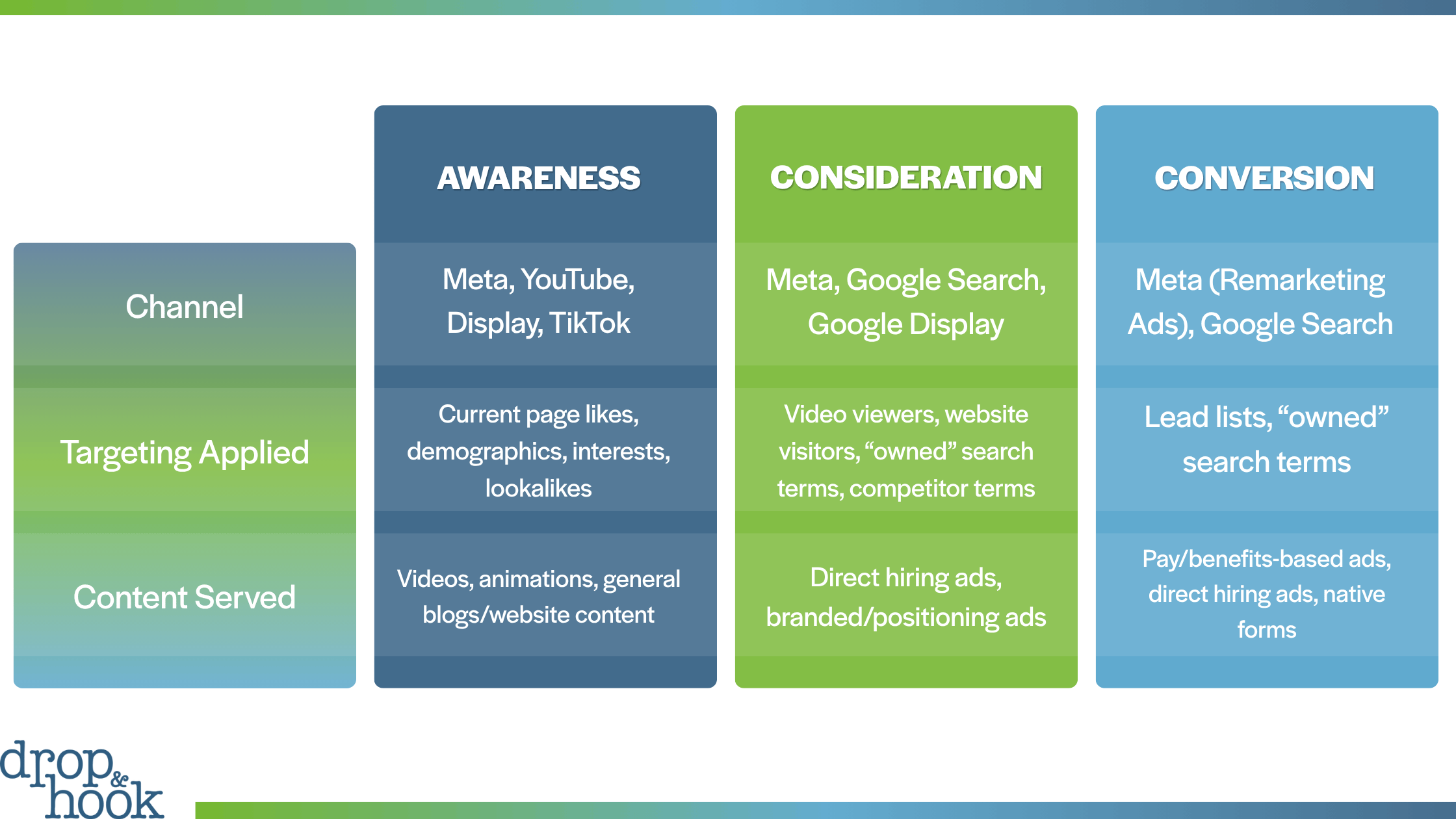
The same logic applies to B2B sales prospecting or logistics company brand awareness. You always start by mapping your audiences (warm and cold), their lifecycle stage, and then selecting channels and content to match.
Part Three: How To Allocate a Small Budget Across Channels
Why Paid Ads Are Worth It Even on a Modest Budget
Even a small paid budget does things that organic content simply cannot promise:
It reaches net-new audiences. Organic posts on LinkedIn, Facebook, or Instagram are shown predominantly to people who already follow you. Paid can extend your reach to cold audiences who fit your targeting criteria but have never encountered your brand.
It guarantees placement. Organic reach is algorithmically determined. Paid placement is, within your targeting parameters, guaranteed.
It’s measurable in ways that organic isn’t. Click-through rates, cost per lead, cost per application, impression share, etc., paid gives you data that organic brand-building efforts simply can’t replicate.
It validates your messaging fast. Running paid digital ads, even on a small scale, is the fastest way to test whether your creative and copy are resonating with your target audience. You’ll learn more in two weeks of a paid test than in months of organic posting.
It accelerates lead generation timelines. Organic content builds equity over time. Paid generates leads now. For teams under pressure to show ROI on their marketing investment, paid is the fastest path to demonstrable results.
How to Allocate a Small Budget Wisely
If you’re working with a total paid media budget of $1,000-$3,000 per month, here’s a practical framework:
For B2B logistics companies (freight brokerage, 3PL, carrier sales):
- Start with Google Search targeting your owned brand terms and high-intent service keywords. This captures warm demand that already exists and converts efficiently.
- Layer in LinkedIn for awareness and consideration with decision-makers if your budget allows. Even a modest LinkedIn campaign can generate meaningful impressions among the right job titles.
- Add Google Display retargeting for website visitors. This is low-cost and keeps your brand visible to prospects who have already shown interest.
For driver recruiting:
- Meta (Facebook) is your workhorse. Start with boosted posts or lookalike audiences at the awareness stage, then build retargeting audiences from viewers and engagers.
- As your audience grows, shift more budget toward conversion-focused campaigns targeting lead lists and owned search terms.
The universal rule: don’t spread it too thin. It is better to do one channel well with an adequate budget than four channels poorly. An underfunded campaign on every platform generates enough data to be confusing but not enough to be useful.
Budget-Stretching Tips for Transportation & Logistics Marketers
- Go niche before going broad. Start with the most specific, highest-intent audience you can define. As you build data and conversion history, you can expand. Broad audiences on a small budget generate impressions, not pipeline.
- Build an ad series, not a single creative. Even with strong creative, a cold prospect may need three to five exposures before taking action. Plan your budget for a sequence: introduce your brand → share your value proposition → then make a direct ask. This is much better than a single ad.
- Use video and events as your top-of-funnel entry points. Video views and event registrations are low-cost ways to identify engaged audiences. Once someone has watched 50% of your video or attended a webinar, they’re a warm audience you can retarget at a fraction of the cost of cold prospecting.
- Don’t outspend your media budget on creative production. The most common small-budget mistake: spending 80% of the budget on the video or the graphic, then running it on $200. The ad needs sufficient budget to run. Allocate your production budget accordingly, and remember that authentic, simple creative often outperforms polished production in paid social.
- Retargeting is the highest ROI tactic for small budgets. Once you’ve run any top-of-funnel campaign, organic or paid, you have the ability to retarget website visitors, video viewers, and social engagers. These audiences already know who you are. The cost per click and cost per conversion for retargeted audiences are dramatically lower than cold prospecting (are you sensing a pattern here?). If you’re just starting with paid ads, building a retargeting audience from your existing organic traffic is the single best first investment.
Part Four: What to Measure and When to Call It a Win
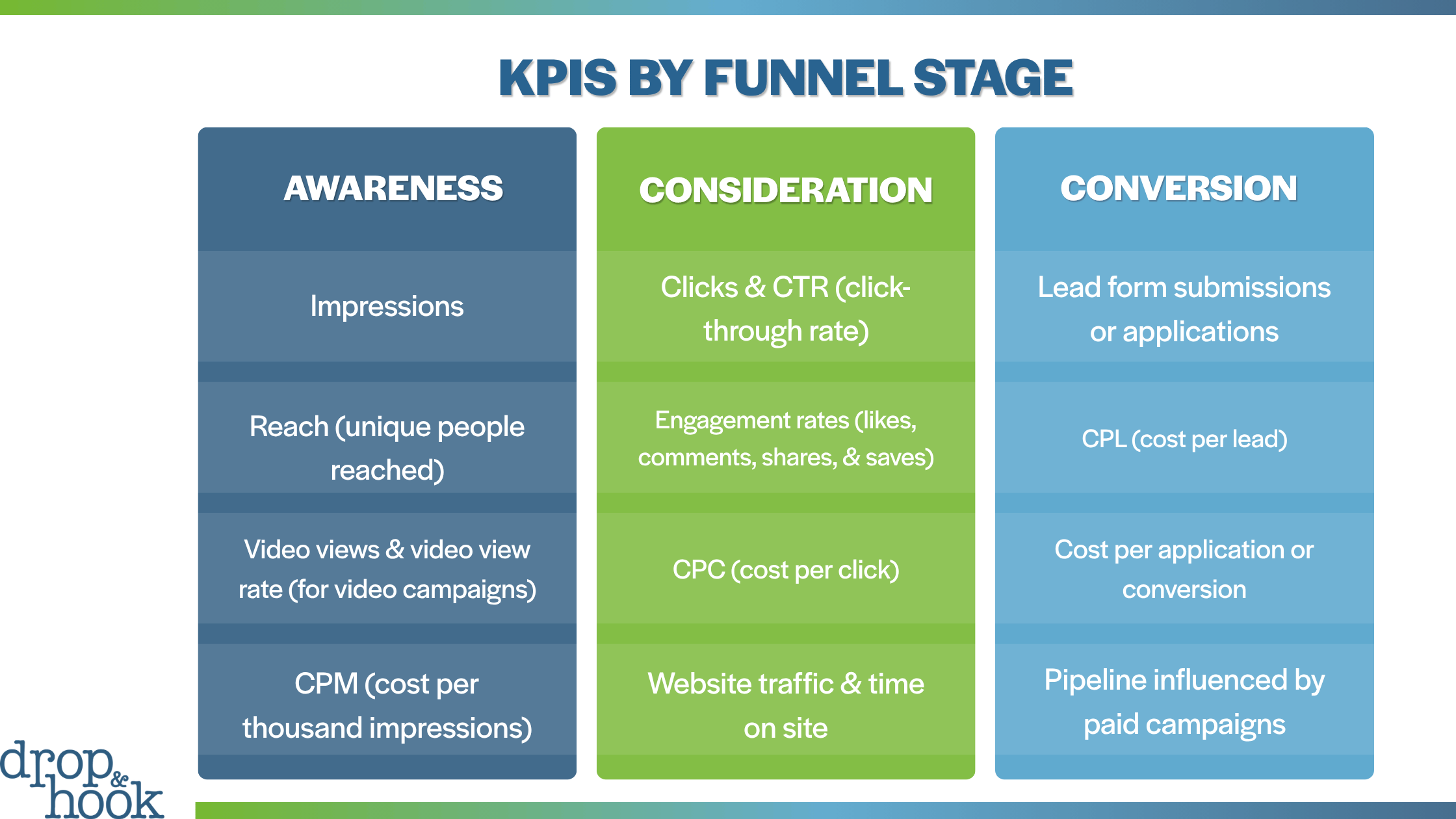
KPIs by Funnel Stage
Measuring paid ad performance requires knowing what you’re optimizing for at each stage of the funnel. Tracking conversion metrics on a brand awareness campaign will always look disappointing, just as tracking reach for a conversion campaign misses the point.
When to Call It a Win vs. Cut Your Losses
There’s no universal timeframe, but here are general benchmarks for small-budget campaigns:
Give it at least 4-6 weeks before drawing conclusions. Most platforms need time to exit the “learning phase” of campaign optimization. Cutting a campaign after one week generates noise, not signal.
Look for directional performance within 2 weeks. You don’t need to wait six weeks to know if something is badly off. If your CTR is dramatically below platform benchmarks, or your cost per click is unsustainably high relative to your budget, that’s a signal to adjust targeting or creative.
Indicators to keep going:
- CTR at or above platform benchmarks (LinkedIn: ~0.44-0.65%; Google Search: varies by keyword, but 2-5% is solid for transportation & logistics; Meta: ~1-2% for cold audiences)
- Cost per lead is within a reasonable range relative to deal size
- Quality of leads is improving over time as targeting is refined
Indicators to pause and reassess:
- Very high impression count but near-zero clicks (creative or offer isn’t resonating)
- Very high click count but zero conversions (landing page disconnect)
- Budget is exhausting quickly on broad audiences with no conversion data
Frequently Asked Questions
How much should a small logistics company spend on LinkedIn ads?
LinkedIn’s minimum suggested spend for a local transportation and logistics audience is around $170-$690 per month based on platform forecasts, but to generate meaningful data, most practitioners recommend a minimum of $1,000/month per campaign. LinkedIn is the most expensive platform on a CPM and CPC basis, which means it works best when your target audience is highly specific (job title, industry, seniority) and your product or service has a strong value proposition for decision makers. If your budget is very limited, start with Google Search to capture existing demand, and save LinkedIn for when you have more to invest.
Should a freight broker use LinkedIn or Meta?
For B2B paid social for logistics companies and freight brokers targeting shippers, LinkedIn is generally the strongest choice because it lets you reach supply chain managers, logistics directors, and operations VPs directly by job title and company. Meta is better suited for driver recruiting, consumer-facing campaigns, or broad brand awareness plays where lower CPMs matter more than precise professional targeting. If your goal is to find shippers and business customers, LinkedIn ads are a more targeted investment.
What’s the minimum budget to run paid ads effectively in transportation and logistics?
There’s no single right answer, but a practical minimum for a meaningful test in transportation and logistics is $500-$1,000/month per campaign. Below that threshold, you may not accumulate enough data to make optimization decisions, and platform algorithms may not exit the learning phase. For shoestring budgets, prioritizing one channel and building from there is better than spreading across multiple platforms at insufficient spend levels.
Are digital ads effective for truck driver recruiting?
Yes! And the data backs this up. “Approximately 82% of truck drivers use Facebook, making it one of the largest digital channels for reaching CDL drivers,” according to O Trucking, offering the ability to target by geography and interest at lower CPMs than LinkedIn. Paid digital ads for driver recruiting let you reach drivers who aren’t actively job searching (brand awareness campaigns) as well as those who are evaluating options (conversion campaigns). The key is building a full-funnel strategy: start with video and employer brand content to warm cold audiences, then retarget with specific job offers and pay-based messaging.
Is TikTok worth it for trucking and logistics companies?
For driver recruiting, especially for carriers looking to reach younger CDL drivers, TikTok is increasingly worth exploring. The 2024 TMSA Marketing & Sales Metrics Study found 28% of transportation & logistics marketers now use TikTok, up from 23% in 2022, a remarkable growth trajectory for a platform that wasn’t even on the TMSA survey in 2020. It is not yet proven for B2B sales outreach, but for employer branding, day-in-the-life driver content, and culture-forward recruiting among younger audiences, it’s a legitimate channel with a platform minimum of just $50/day.
What’s the difference between retargeting and prospecting?
Prospecting means targeting cold audiences, people who have never interacted with your brand. Retargeting means serving ads specifically to people who have already encountered you in some way: they visited your website, watched your video, followed your page, or attended an event. Retargeting audiences are warmer, more engaged, and significantly cheaper to convert. For small budgets, building retargeting audiences from your organic traffic and top-of-funnel content is one of the highest-leverage moves you can make.
How do I know if my paid ads are working?
Start by getting clear on what “working” means for your specific campaign goal. For awareness campaigns, success looks like an efficient reach (low CPM, high video view rate). For lead generation, success is cost per lead relative to the lifetime value of a customer. The 2024 TMSA study found that 42% of transportation and logistics marketers track digital advertising ROI, which means more than half aren’t tracking it at all. Set up conversion tracking before you spend a dollar. Know your target KPIs in advance. And give campaigns enough runway (4-6 weeks minimum) to produce meaningful data before cutting.
The Bottom Line
Paid advertising on a small budget isn’t about doing less; it’s about doing fewer things better. The transportation and logistics marketers who see real returns from modest paid budgets share a few traits: they know their audience precisely, they match their content to the audience’s lifecycle stage, they go deep on a single channel before expanding, and they let retargeting do the heavy lifting at the bottom of the funnel.
You don’t need a massive paid budget to compete. You need a strategy.
Looking for help with building a paid social strategy for your transportation or logistics company? Book a call with Drop & Hook to talk through your goals and see how we’d approach your specific audience.