

I was sitting in an internal strategy meeting recently, talking through seasonal content ideas, and I threw out what felt like the most obvious example in freight: peak season.
Everyone in logistics knows peak season. It's the stretch when volumes climb, capacity tightens, rates jump, and everyone's phone rings a little more. Easy blog topic, right?
Then my coworker pointed out that peak season for their client is a completely different time of year than mine. My client's busy months were winding down right as theirs were ramping up. Same supply chain industry, same trucks on the same highways, completely different calendars.
It was a small moment, but it stuck with me. "Peak season" gets talked about like it's one universal event. In reality, it depends entirely on what you move, who you move it for, and where it's going. Furthermore, the traditional peak season isn’t what it used to be. It’s starting earlier and lasting longer than it has before. So I wanted to break down what peak season actually looks like across different corners of the supply chain and what that means for transportation and logistics marketers.
Why "peak season" means something different to everyone
In my mind, when most people say peak season, they mean the traditional retail rush. Imports surge in late summer and early fall, goods move inland to distribution centers, and then everything flows out to stores and doorsteps ahead of the holidays.
That cycle is real, and it still shapes a big chunk of the freight market. But it's only one version of peak. A produce shipper is already through their busiest stretch by the time retail gets going. A holiday gift brand's crunch doesn't hit until the orders start flowing. A grain hauler is watching the harvest, not Black Friday.
For carriers, brokers, and 3PLs, understanding these overlapping cycles matters. Capacity that's wide open in one segment can be completely spoken for in another, and demand in one vertical can tighten the market for everyone else.
Peak season by industry
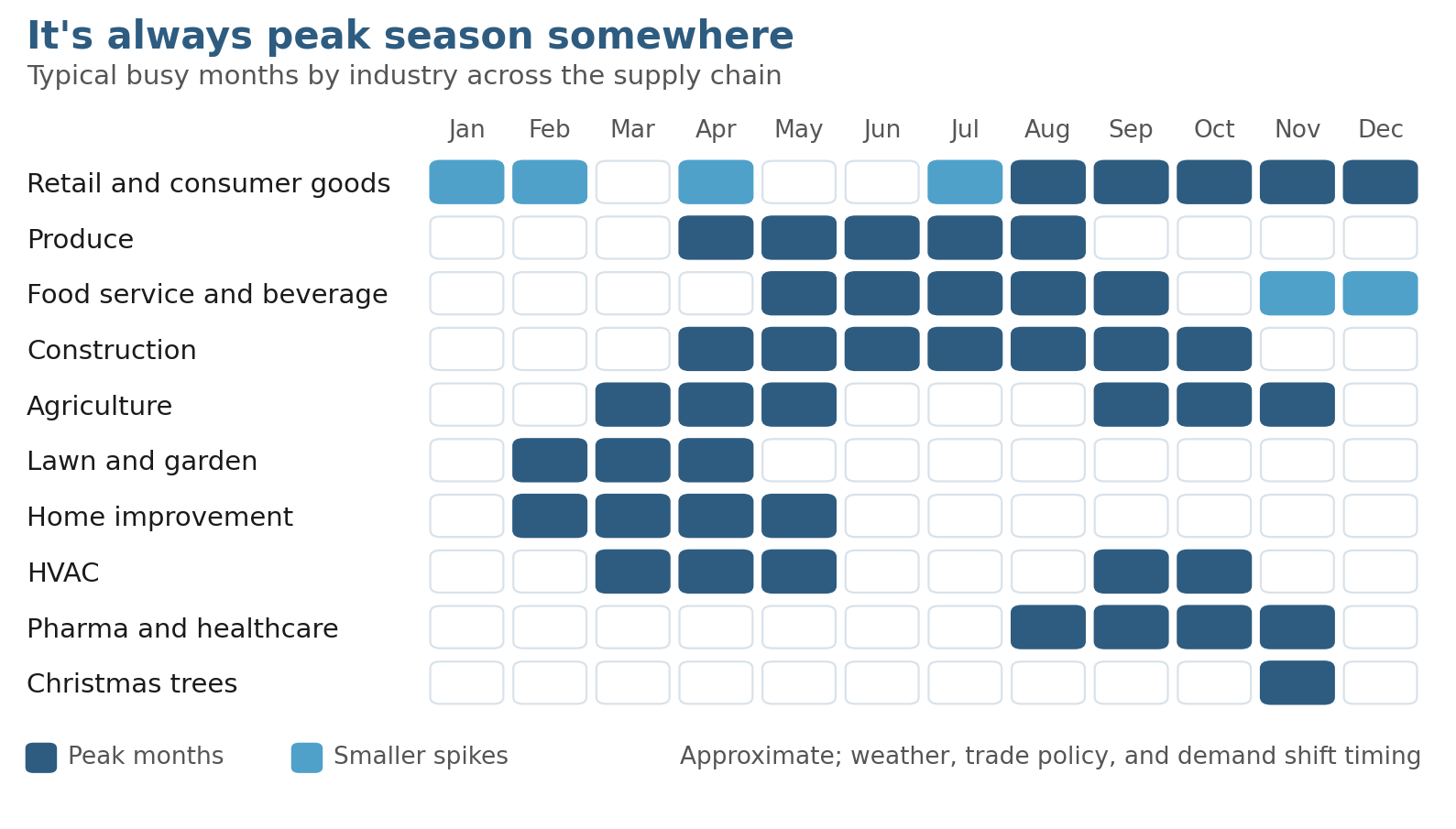
Here's a quick look at how those calendars stack up. Automotive is left off the chart because its volumes run steadier year-round.
Retail and consumer goods
Retail and consumer goods drive the version of peak that gets the most headlines, but it's really a string of peaks spread across the year. Valentine's Day, Easter, back-to-school, and summer sales events like Amazon Prime Day each bring their own spikes for apparel, gifts, and CPG. The biggest push is still the holidays. Import volumes typically build through late summer and into fall as retailers stock up, and that surge runs straight through the ports, where drayage operators feel it first. By the time shoppers hit stores in November and December, most of the heavy freight lifting has already happened upstream. Then parcel and last-mile networks carry the holiday ecommerce rush, followed by a wave of returns in January.
Even this calendar doesn't always behave. For a while in 2026, it looked like May would be the busiest import month of the year, at 2.24 million TEU, as retailers brought goods in early ahead of potential tariff increases. But volumes stayed high through the summer, and the National Retail Federation's Global Port Tracker now forecasts September as the busiest month at 2.31 million TEU, pulling peak right back to its traditional late summer and early fall timing (NRF Global Port Tracker, Sept. 2026).
Produce
Produce season runs on a completely different clock. It generally kicks off in spring as harvests begin in the southern U.S. and imports cross from Mexico, then moves north as growing regions come online through the summer. Reefer demand spikes during this stretch, and because it overlaps with other spring freight, produce season is often one of the first signals that the truckload market is tightening for the year.
That overlap was on full display in May 2026. According to DAT, national reefer linehaul rates jumped a record $0.32 per mile in a single week as the start of produce season collided with CVSA Roadcheck week, which drove reefer equipment posts down 12%. (DAT Reefer Report, May 20, 2026)
Food service and beverage
Food and beverage have more than one peak. Summer is big for beverages, grilling, and outdoor dining, roughly Memorial Day through Labor Day. Then the holidays bring another surge, from Thanksgiving turkeys to holiday baking and party supplies. Food service distributors also follow restaurant and travel patterns, which lean toward warmer months.
Automotive
Automotive freight is steadier than most, but it has its own rhythm. Production tends to follow planned plant shutdowns, often in summer for retooling and again around the year-end holidays, along with the changeover to new model years. Parts and finished vehicle shipments move around those schedules rather than around consumer shopping seasons.
Construction and building materials
Construction is a spring through fall business in most of the country. As weather improves, demand for lumber, steel, and other materials climbs, and flatbed capacity gets tight. Activity slows through winter, especially in northern markets.
Agriculture
Agriculture has two big moments. Spring brings planting season and the inputs that go with it, like seed, fertilizer, and equipment. Fall brings harvest and the outbound flow of crops to storage, processing, and export, which is also when grain traffic on the railroads picks up.
Lawn and garden
Lawn and garden products ship early. Retailers need mulch, soil, fertilizer, and outdoor equipment on shelves before spring, so much of that freight moves in late winter and early spring.
Home improvement
Spring is the biggest selling season for home improvement retailers, as homeowners tackle projects once the weather turns. That means inbound freight for tools, building supplies, paint, and fixtures builds through late winter so shelves are stocked in time. It overlaps heavily with lawn and garden and construction, which can make early spring a crowded stretch for van and flatbed capacity.
HVAC
HVAC is one of the few industries with two clear peaks. Air conditioning units and parts ship ahead of summer, and furnaces and heating equipment ship ahead of winter. A heat wave or early cold snap can also trigger a scramble for replacement equipment on short notice.
Pharmaceuticals and healthcare
Healthcare freight is steady year-round, but flu season creates a noticeable push. Vaccine distribution ramps up in late summer and fall, and because those shipments are temperature-sensitive, it puts extra demand on reefer and specialized cold chain capacity.
The one-hit wonders
Some commodities pack their entire peak into one short window, and Christmas trees are the most festive example. For a few weeks each November, growers in places like the Pacific Northwest and North Carolina cut, bale, and load millions of trees headed for lots and retailers across the country. It's a sprint, not a marathon: the trees have to arrive fresh, on time, and before shoppers start their search for the perfect one. For the carriers hauling them, peak season smells a lot like pine. Trees aren't alone, either. Pumpkins spike in early fall, turkeys move in a rush ahead of Thanksgiving, and cabbage has its moment right before St. Patrick's Day.
This definitely isn't every industry with a peak season. There are plenty more I didn't cover here, but these are the ones I hear about most from the clients and partners I work with.
The moments that ripple across every segment
Even with all these different calendars, a few events hit nearly everyone:
- Lunar New Year: Factory shutdowns in Asia push importers to front-load shipments ahead of the holiday, then create a lull afterward.
- CVSA International Roadcheck: The annual inspection blitz each spring pulls some trucks off the road for a few days, tightening capacity at a time when produce season is already heating up.
- Holiday weeks: Around Memorial Day, the Fourth of July, Labor Day, Thanksgiving, and Christmas, many drivers take time off, which squeezes capacity even when demand holds steady.
- Month and quarter end: Shippers pushing to hit numbers can create short, sharp volume spikes regardless of the season.
- Weather: Hurricane season and winter storms can scramble networks and spike spot rates in affected regions overnight.
- Policy and trade shifts: Tariff announcements and trade changes can pull shipments forward or push them back, creating peaks that have nothing to do with the calendar.
Freight tech: where every season is someone's peak
If peak season is complicated for carriers and brokers, it's even more complicated for freight technology companies. A single platform can serve customers from nearly every industry on this list, which means at any point in the year, some portion of its customer base is heading into its busiest stretch.
TMS
A transportation management system might have brokerage customers specializing in produce, others focused on retail, and others moving building materials. Each of those brokers hits peak at a different time. For the TMS provider, that means there's rarely a true off-season, just a rotating group of customers who need the platform to perform under pressure.
WMS
Warehouse management systems face the same challenge on the fulfillment side. A WMS provider might support an ecommerce fulfillment center bracing for Q4, a food distributor gearing up for summer, and a home improvement supplier stocking for spring, all at once. Each warehouse's peak brings a surge in orders, labor, and inventory movement that the system has to handle.
ELDs and telematics
ELD and telematics providers serve carriers of every size and specialty, from reefer fleets running produce in the spring to flatbed operators hauling construction materials through the summer. When their carrier customers are busiest, hours of service, compliance, and visibility matter even more, and so does reliable support.
Cross-border technology
Cross-border platforms sit at the intersection of multiple industries and trade flows. Produce imports from Mexico, automotive and manufacturing shipments, and retail goods all move through the same crossings on different timelines. Trade policy and tariff shifts add another layer, pulling shipments forward or holding them back with little warning.
Load boards
Load boards are a real-time reflection of every peak season on this list. Reefer postings climb during produce season, flatbed activity picks up with spring construction, and van volumes swell ahead of the holidays. Because load boards connect brokers and carriers across every vertical, the shifts in supply and demand show up there first, often before they show up anywhere else.
Visibility platforms
Visibility platforms serve shippers, brokers, and 3PLs who all want the same thing: to know where their freight is. That need gets sharper during peak, when capacity is tight, delays are more common, and customers expect updates. A visibility provider might be supporting a retailer tracking holiday inventory, a food shipper monitoring temperature-sensitive loads, and a manufacturer watching cross-border parts shipments, all in the same week.
For freight tech companies, the takeaway is simple: you're not planning for one peak season, you're planning for all of them. Your product, your support team, and your marketing all need to account for customers who are busy at different times of year.
What this means for logistics marketers
That moment in our strategy meeting also changed how I think about seasonal content. If you're on the marketing or sales team at a carrier, brokerage, 3PL, or freight tech company, your content calendar should follow your customers' peak season, not a generic industry one.
Your customers feel the crunch during peak, but they make their decisions long before it. Take infrastructure projects. Those jobs often go to bid and get contracted well ahead of when crews break ground, so logistics partners are frequently locked in before the busy season starts. A produce shipper is lining up reefer capacity before spring. An ecommerce brand is planning holiday fulfillment in the middle of summer.
That's why timing matters so much for marketers. Show up with a "peak season" message while your customer is in the thick of it, and you're already too late. It can even feel out of touch, like you don't understand how their business works. Your content has to meet customers when they're planning, which means the person creating it needs to understand the customer's business well enough to know when that is. If your company serves customers across several industries, one generic "peak season" campaign won't land with any of them.
A few ways to put this into practice:
- Build your calendar around your customers' peaks. Publish capacity and planning content a few months before their busy season, when they're making decisions, not in the middle of it.
- Segment by vertical. In your CRM, tagging contacts and companies by industry or commodity lets you send seasonal messaging only to the customers it applies to. In HubSpot, for example, that can be as simple as building a segment off an industry property.
- Speak to their season, not yours. Customers want a partner who already knows when their crunch hits. Showing that knowledge in your content builds trust before the first quote.
- Use the slow months. When your core verticals are quiet, that's the time for case studies, thought leadership, and relationship-building content.
Knowing every peak comes from living it
Pulling this post together reminded me how much of what I know about peak season came from being in the room, not from reading about it.
I've spent the past eight years in this industry. I've worked in freight tech. I've had broker clients, carrier clients, and tech clients. I've partnered with TMS and ELD providers, walked the floors at trade shows, and spent time with people across just about every segment of the supply chain.
That experience is why peak season felt like such an easy example in our strategy meeting, and why it turned out to be such a good lesson. Freight isn't one industry with one set of priorities. It's dozens of them, each with its own rhythm, pressures, and customers.
That's the lens we bring to every client at Drop & Hook. We don't have to learn what keeps a produce broker up at night or why a TMS provider's customers are busy at completely different times of year. We already know, because we've been in those conversations. So when we create content that sounds like it came from someone inside the industry, it's because it did.
If you're rethinking how your content lines up with your customers' seasons, we'd love to compare notes. Drop us a line and bring your calendar. No matter when your peak season hits, our dock door is always open.